Protix Webinar (02/10/2020)
- Marie Obenhaus

- Oct 18, 2020
- 4 min read
Updated: Dec 5, 2020
Protix is an organization that focuses on the manufacturing and supplying of insect ingredients for animal and human consumption. The company was founded in 2009 by Kees Aarts, with the headquarter located in the Netherlands. According to Protix’s website, they are the market leader in terms of verifiable and scalable insect breeding. One key ingredient to the production is the black soldier fly (BSF), whose larvae has a high protein content which in turn can be used for feed and food. One of the businesses aspirations is to ‘bring the food system back in balance with nature’.
I first became aware of the webinar through a post on LinkedIn. This was the first time I heard of the company, but not the first time I heard of insect based feed and food. During my minor “Sustainable Resource Management” at VHL, I got first introduced to the black soldier fly and its huge potential. Moreover, we were assigned a small project to do some research on this animal and create a presentation of its benefits. I thought this to be very interesting as well as inspiring to start looking into new directions and the connected possibilities. I eventually decided to sign up for the webinar because I think it is a great opportunity to be able to take part in something that would otherwise not be possible as well as to extend my own knowledge on this topic by listening to experts in this field.
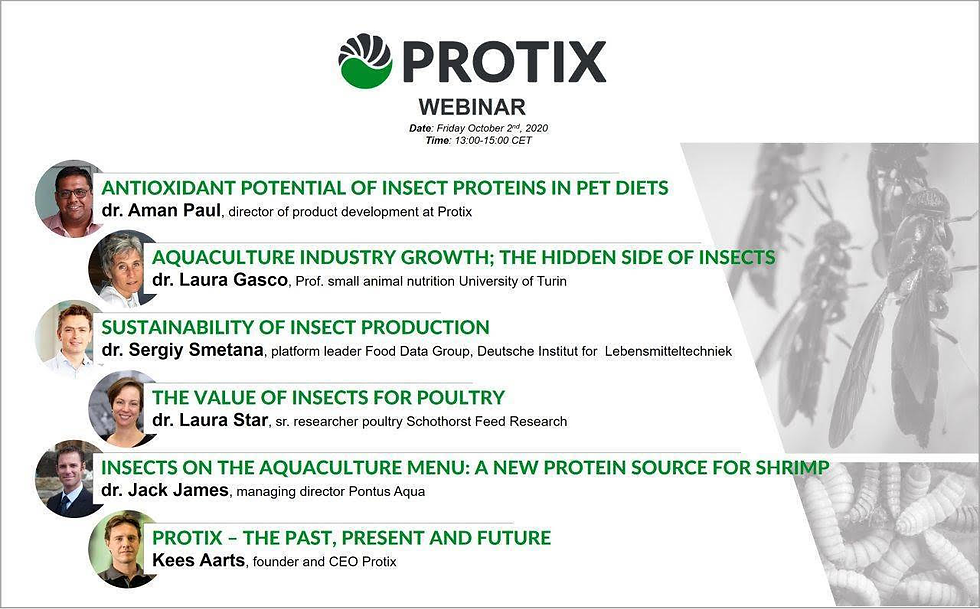
The key speakers of this webinar included:
· Dr. Aman Paul, director of product development at Protix
· D. Laura Gasso, Prof. small animal nutrition University of Turin
· Dr. Sergiy Smetana, platform leader Food Data Group, Deutsche Institution für Lebensmitteltechnik
· Dr. Laura Star, sr. researcher poultry Schothorst Feed Research
· Dr. Jack James, managing director Pontus Aqua
· Kees Aarts, founder and CEO Protix
To start the webinar off Kees Aarts mentioned that nature is using insects as food, so why shouldn’t we follow natures example? In my opinion this is a good question. Nature is usually making use of everything that there is, however it is the human that is picky and discarding aspects that might be very beneficial but not appropriate to their standards.
The first speaker, dr. Aman Paul talked about the antioxidant potential of insect proteins in pet diets. Personally, my first thought would by why should I feed my dog insects? They naturally don’t have a diet based on this, right? However, the diet is not entirely based on insects, as well as not the whole insect as it is but rather broken down into a powder or in the form of actual pet food in combination with other ingredients. The additional benefits that this provides such as the prevention off inflammatory damage, which has been proven by studies and research, makes this a much more attractive product. Furthermore, the production process of the goods is not only making use of the actual end product but also the by-products which makes it more sustainable in terms of waste.
Dr. Laura Gasso continued with her presentation about the aquaculture industry growth and the hidden side of insects. She talked about the outcomes of a study which compared the outcomes of yellow catfish or black soldier fly larvae meal being fed to other type of fish. The study showed that the BSF had very apparent positive effects in the growth performance and the immune indexes of the fish that were fed this type of diet. This is an interesting aspect to me since it shows that rather unconventional methods can bring many advantages to the animals themselves and can have an impact on the production of black soldier flies as well as the upbringing of fish for humans to consume.
Moreover, dr. Sergiy Smetana spoke about the sustainability of insect production. He mentioned that a life-cycle assessment can be used in order to assess the actual impacts on sustainability comparing conventional meat substitute production and the insect production. The overall outcomes illustrated that the environmental impact can be even further reduced in terms of upscaling the insect production which will also improve the efficiency as well as making use of the side-streams or alternative sources of energy that are currently not being utilized to their full potential. In addition to what I had learned during my minor at VHL I think this was another very interesting part to listen to since it repeated what was taught, however this actually happens in real life and is not just an example case that was made up by a university. To me this is nice to see that what we learn is actually being applied in real life and that it adds value to businesses being in a decision making process.
Lastly, dr. Laura Star’s presentation was on the topic of the value of insects for poultry. As mentioned during the presentation, insects add value to two aspects including the welfare and the nutrition of poultry. She was the first one to mention that there are some legislative restrictions towards the possibilities. This makes it even more real to me since everyone always talks about how great it is and all the possibilities, however in ‘real-life’ it looks a little different and not everything one can think of is actually allowed to be pursued.
Furthermore, I believe that there is a lot of potential for insect based protein and animal diets as well as an ingredient in the diets of humans. However, this might need more research as well as the rules and regulations have to change in order to allow such things to happen. Once these have change in favor of implementing insects in more aspects of our everyday life, we will be able to experience many of the mentioned benefits and improve our way of living as well as reducing the harmful environmental impact.

Comments