Global Mind Monitor - Outcomes and Reflection
- Marie Obenhaus

- Nov 13, 2020
- 6 min read
Updated: Dec 5, 2020
What is the Global Mind Monitor?
The Global Mind Monitor is a comprehensive, non-commercial tool in the field of internationalisation. It has been developed to be used by students and staff involved in programmes that have internationalisation and intercultural learning outcomes as part of the curriculum, but is available for professionals in other sectors as well. The Global Mind Monitor has been initiated by the Research Center International Relationship Management of Zuyd University of Applied Sciences. The Global Mind Monitor can assist the development of high quality internationalisation learning outcomes. These are increasingly demanded in many different industries where internationalisation and multicultural teams have become the new normal.
(Source: Global Mind Monitor)
Over the course of a three year period I have completed the same questionnaire for four times. The first time being at the start, and therefore shortly after moving to the Netherlands, of my first year studying International Business and Management (IBMS), and the fourth time being during my sixth semester studying IBMS. Completing these questionnaires has helped me to understand what the different things, that will be discussed further down, actually meant as well as what my positioning on these scales is. It was also very interesting to see how my own perception of my abilities, skills and personality changed during these three years and how the accuracy developed from taking the questionnaire for the first time to the fourth. I believe that I was also able to get to know myself better during these years which in turn contributed to making better estimations and to see the value in the outcomes.
The following chart illustrates the development of my language skills. My mother language is German. Before I came to the Netherlands I spoke German all of the time except during English lessons in school which might have been a total of one to three hours a week. Therefore, I ranked my German skills pretty high when I took the test for the first time. I was very confident with my skills and abilities.
I have had English lessons since I was eight years old (born in 1998). I always enjoyed learning new languages and I was fascinated by English. Moreover, I really liked the language, however I was and still am in certain situations a very shy child and it often takes some time for me to get comfortable with a situation or people which will then make it easier to communicate and collaborate. Since I was always more to myself and rather scared of trying new things which is also related to making mistakes, speaking in another language to other people, even if it was during school lessons, was a quite scary thing to me. This resulted in me not being able to progress and develop my language skills as much as I would have liked to. Once I came to the Netherlands where I was basically forced to speak either English or Dutch (which I did not at that time) I with others in order to communicate and work on projects for university, I was able to become more confident in speaking as well as making mistakes. I realized that in order to get better at something, you more or less have to make mistakes since otherwise there is no way to improve and learn new things.
During my first and second year of studying at NHL Stenden, we had to follow a Dutch language course. As mentioned before, I am very interested in learning new languages and I think it is a fun thing to do and can also be helpful in many situations. I enjoyed learning Dutch and taking to others in class. However, the same problem as before occurred where I had no confidence in speaking Dutch to others outside of class. This was also enhanced by how easy it is to just speak English, for example at the grocery store. When I read a text in Dutch I understand most of it, the same goes for when I hear others talking in Dutch, however when I have to speak Dutch myself I become insecure since I think too much about which word to use which. Since this created some type of anxiety, I quickly switch to English and just say that I simply do not speak Dutch. In September 2020 I started with survival training in Leeuwarden where it became a habit that the trainers speak Dutch to me and I also answer in Dutch, unless there are certain words that I do not know. I believe that this has helped me to maintain my knowledge of the Dutch language even after the course at university has ended and I do not necessarily have the incentive to study/speak Dutch.
The second measurement for German shows a big drop from where it rose again in the following measurements. This is due to me having had troubles with switching between languages when I, for example travelled back to Germany for the holidays. Since I was so focused on speaking and writing everything in English and not really using my German, it was rather difficult for me to find the right words in German once I had to use this language again to talk to my family. However, I also noticed that over time this issue became much smaller and only from time to time I struggle to find the right word or how to express a thought in general. I believe that just as it takes practice for so many other things, practice also helped me in switching between languages when necessary and also with becoming more confident in my own abilities and skills.

The next chart shows the development of my multicultural personality. I always had the feeling that I was quite openminded and I am interested in experiencing/learning about other peoples views and beliefs. Furthermore, I also believe that coming to the Netherlands to study International Business and Management has helped me with developing and improving this trait and to become more aware towards certain aspects that I would otherwise not have encountered if I would have stayed in my home country. Additionally, something that has also helped with increasing my openmindedness as well as my cultural empathy was the Trade Mission Thailand 2019. Before going on this trip, I was already able to get used to the different cultures I was encountering during my first year of studying in the Netherlands, but going to a country which is different in so many ways from Germany or the Netherlands, was a very interesting and great experience which has taught me many things.
When I filled in the questionnaire for the first time, the same thing happened where I was overestimating my abilities and skills. Over time I realized that I am not as flexible as I would like to be and that I am more comfortable with having a schedule or outline for when what is supposed to happen as well as having specific deadlines for projects or certain parts of a project. This usually helps me to keep track of time and progress as well as making sure that the deadline is met with a satisfactory result in the end. However, after being in this situation for almost three years, I have learned to compensate when it comes to working in a team with other people. I was able to develop my flexibility to some extent in that I do not get stressed when people are not meeting their deadlines, showing up late to meetings, or simply being unprepared. I have learned that one has to make the best out of such situations and work with the assets that exist in that particular moment.
Regarding taking social initiative, it has been mentioned before that it is not so easy for me to simply go up to others and talk to them in whatever language. Although I am still struggling with this, I have been able to become more comfortable in such situations through to putting myself in situations where I was required to make the first step to engage a conversation with someone unknown.

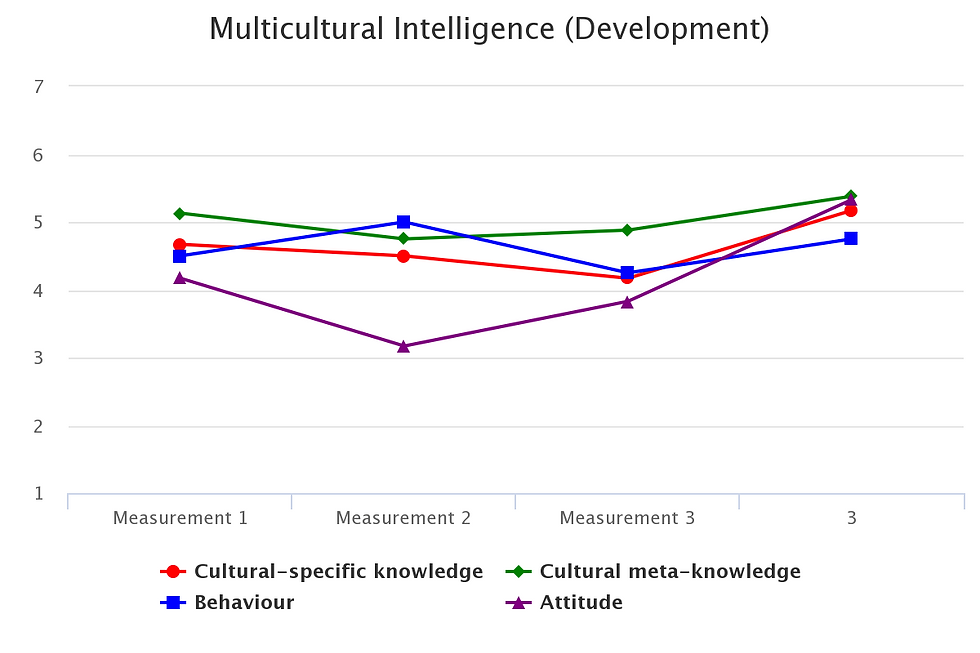
The last chart portrays the development of my multicultural intelligence. I believe that the graphs for cultural-specific knowledge, behavior, cultural-meta-knowledge, and attitude can be grouped together for the statement that the ratings changed according to what happened more or less immediately before filling in the questionnaire during for the respective period. The starting points were, now that I am looking back at the events that happened as well as that it was my first time filing in the questionnaire, most likely ranked too high. This is presumably due to me having moved to a new country, experiencing all these new aspects and having to discover myself in a new way. Furthermore, the changes over time in the rankings were influenced by forces such as the Trade Mission Thailand 2019, having lived in the Netherlands for a longer period of time, working in teams with exchange students, doing the minor in “Sustainable Resource and Supply Chain Management”, and some more. All these mentioned aspects had a specific impact on me, my behavior and attitude in terms of becoming more understanding and knowledgeable regarding different cultures due to directly being exposed to them through traveling to another country or having new team members who I only worked together with for one or two assignments. Moreover, I believe that these estimates resemble the reality quite accurately.



Comments